
Construction sites are one of the few workplaces prone to nearly every major category of workplace accident. Falls, injury by machinery, vehicle strikes, fire and explosions, and overexertion all show up regularly on OSHA's incident reports.
That's exactly why, unlike signage in most other industries, safety signs on a construction site aren't just a best practice. They're required by law.
Every jobsite owner and construction manager has seen the same signage at gates and fence lines: color coded panels warning of hazards, restricting access, or instructing workers on safe practices.
But posting a sign isn't the same as posting the right sign in the right place. Get the color, wording, or placement wrong, and you're not just risking a citation.
You're risking a worker missing a warning that actually mattered.
This guide breaks down what OSHA's standard for accident prevention signs (29 CFR 1910.145) actually requires, where signs need to go on an active jobsite, the main categories you're responsible for posting, and practical tips for keeping your signage, and your project, compliant from mobilization to closeout.
Key Takeaways
- OSHA's core signage standard is 29 CFR 1910.145, which governs the design, color, and wording of accident prevention signs and tags across industries, including construction
- Signs and labels must be used any time employees are exposed to hazardous or potentially hazardous conditions that are out of the ordinary, unexpected, or not readily apparent, and must stay up until the hazard is eliminated.
- The three main categories of OSHA safety signs are Danger, Caution, and Safety Instruction signs, each with its own required color scheme.

What Is the OSHA Standard for Safety Signs?
The rule that governs virtually all workplace safety signage is 29 CFR 1910.145, OSHA's specification for accident prevention signs and tags. It sets the design, application, and use requirements for any sign or symbol meant to indicate a hazard serious enough that failing to mark it could lead to injury, illness, or property damage. Under this standard, any new sign installed on a jobsite, or any old sign being replaced, has to meet these specifications.
The standard also spells out when signage is required in the first place. Labels, tags, and signs are meant to prevent accidental injury or illness to employees who are exposed to hazardous or potentially hazardous conditions. They need to stay in place until the hazard is eliminated or the hazardous operation is completed.
In other words, OSHA isn't just regulating what a sign looks like. It's regulating the entire lifecycle of a hazard warning, from the moment a risk appears to the moment it's gone.
Where to Place OSHA Safety Signs
Deciding where signage belongs on an active jobsite can be harder than it sounds. Too far from the hazard and it loses its purpose, too cluttered and workers start tuning it out.
OSHA's standard is direct here: signs must be placed as close and as safely as possible to the hazard they're warning about.
A few practical rules follow from that principle:
- Post at the point of hazard, not just at the entrance. A single sign at the gate doesn't cover a trench opened later near the parking area. That hazard needs its own signage, placed right where the risk actually is.
- Keep signage up for the full life of the hazard. Signs and tags stay in place until the hazard is eliminated or the operation is complete, not until someone remembers to take them down.
- Make sure signs are actually visible. A sign blocked by stacked materials, poor lighting, or foot traffic doesn't meet the intent of the standard even if it's technically posted.
- Pair signage with physical barriers. Signs work best alongside barricades, cones, or fencing that reinforces the warning. See our breakdown of safety barricade colors for how color coding supports this.
- Coordinate with traffic control plans. Where construction affects vehicle or pedestrian routes, signage should align with your temporary road sign plan so drivers and pedestrians aren't getting mixed signals.
Types of OSHA Safety Signs
OSHA classifies safety signs into three main categories under 1910.145, each with a locked in color scheme so the message is instantly recognizable no matter who's reading it or what jobsite they're on.
Danger Signs
Danger signs are reserved for the most severe hazards, situations where a hazard poses an immediate danger and special precautions must be taken. There's no variation allowed in their design: red, black, and white are the only acceptable colors, and every worker on site needs to be trained to understand that a danger sign means stop and take precautions now. Think open excavations, energized electrical equipment, or fall hazards at height.

Caution Signs
Caution signs step down in severity. They're posted to warn of potential hazards or to caution against unsafe practices, not immediate danger, but a risk that still requires attention. The standard color scheme is a yellow background with a black panel and yellow lettering. Workers should understand a caution sign as a signal to take proper precaution, not necessarily to stop work entirely.
Safety Instruction Signs
Safety instruction signs don't warn of a specific hazard. They provide general instructions and suggestions to help workers perform their tasks in the safest manner possible. These use a white background with a green panel and white lettering. On a construction site, this covers things like PPE requirements, muster points, and general jobsite rules.
Within each of these three categories, OSHA signage on a construction site gets more specific. Admittance signs warn visitors about the dangers of entering a restricted area.
General safety signs cover broad topics like sanitation, housekeeping, first aid, and medical equipment. Fire safety signage marks emergency exit routes and firefighting equipment.
Getting familiar with the full symbol library, not just the three core color codes, matters here. Our guide to safety signs and symbols covers the most common pictograms you'll run into on an active site.

Tips to Keep Signs Compliant
Posting the right sign on day one only solves half the problem. Keeping a project compliant means treating signage as an ongoing part of your safety program, not a box you check during mobilization.
- Inspect signs on a regular schedule. Sun and weather exposure fade colors faster than most managers expect, and a washed out caution sign can fail to meet the color specifications OSHA requires. See our post on traffic paint fading and compliance for what to watch for.
- Replace damaged signs instead of patching them. Cracked, bent, or sun bleached signage should be swapped out. Sharp edges or illegible wording on a damaged sign defeats the purpose of posting it in the first place.
- Update signage as the project phase changes. Hazards shift as work moves from excavation to framing to finishing. Signage for hazards that no longer exist should come down as soon as that hazard is eliminated.
- Train every worker and subcontractor on what each color means. OSHA's standard assumes workers already understand the danger, caution, and instruction hierarchy. That only happens through onboarding and toolbox talks.
- Standardize your sign inventory across the site. Sourcing consistent, code compliant signage from a single supplier, like our full safety signs lineup, removes guesswork about colors, materials, and legibility.
- Document your signage plan. Keep a site map showing where signs and barricades are placed, and update it as conditions change so compliance is easy to demonstrate during an inspection.
Trust SONCO to Improve Safety at Your Project
Staying ahead of OSHA's signage requirements takes more than a one time purchase. It takes a partner who understands how jobsite hazards evolve.
SONCO supplies code compliant danger, caution, and safety instruction signage, along with the barricades and traffic control products that work alongside it, so your project stays visible, legible, and inspection ready at every phase.
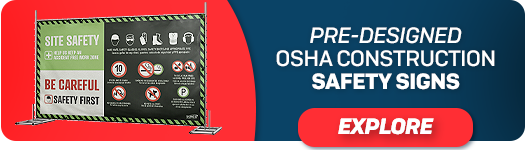
Explore our full line of safety signs and let our team help build a signage plan that protects your crew and your compliance record.
FAQ
What is the OSHA standard for safety signs?
The standard is 29 CFR 1910.145, which sets specifications for the design, colors, and wording of accident prevention signs and tags. It requires that signage be used any time employees face hazardous or potentially hazardous conditions that are out of the ordinary or not readily apparent, and that signs remain in place until the hazard is eliminated.
What signage is required by OSHA?
At minimum, jobsites need Danger signs for immediate hazards, Caution signs for potential hazards, and Safety Instruction signs for general safety guidance. Depending on the site, projects may also need admittance signs at restricted areas, general safety signs, and fire safety signage marking exits and firefighting equipment.
What are the 5 main safety signs?
Beyond OSHA's three core categories, many safety programs expand the list to five: Danger, Warning, Caution, Notice, and Safety Instruction signs. Each uses a distinct color, red, orange, yellow, blue, and green respectively, so hazard severity is instantly recognizable regardless of the specific wording on the sign.
What are the 7 types of safety signs?
A broader signage system, drawing on ANSI and international conventions, typically includes Danger, Warning, Caution, Notice/Safety Instruction, Prohibition signs (no smoking, no entry), Mandatory action signs (hard hat required, PPE required), and Emergency information signs (fire equipment, first aid, exit routes).
Where should OSHA safety signs always be placed?
OSHA safety signs should always be placed as close and as safely as possible to the hazard they're warning about, and should remain visible for as long as that hazard exists. Signs should never be tucked away from the actual point of risk or obstructed by materials, equipment, or poor lighting.